University & research labs
Quantum optics, photonics, and time-resolved measurement teams looking for a practical module.
European market introduction
For research, prototyping, and integration
We are introducing compact photon-counting modules to the European market — combining reliable hardware manufacturing with software interfaces, documentation, and integration support for laboratories, research teams, and system integrators.
Based in Sweden
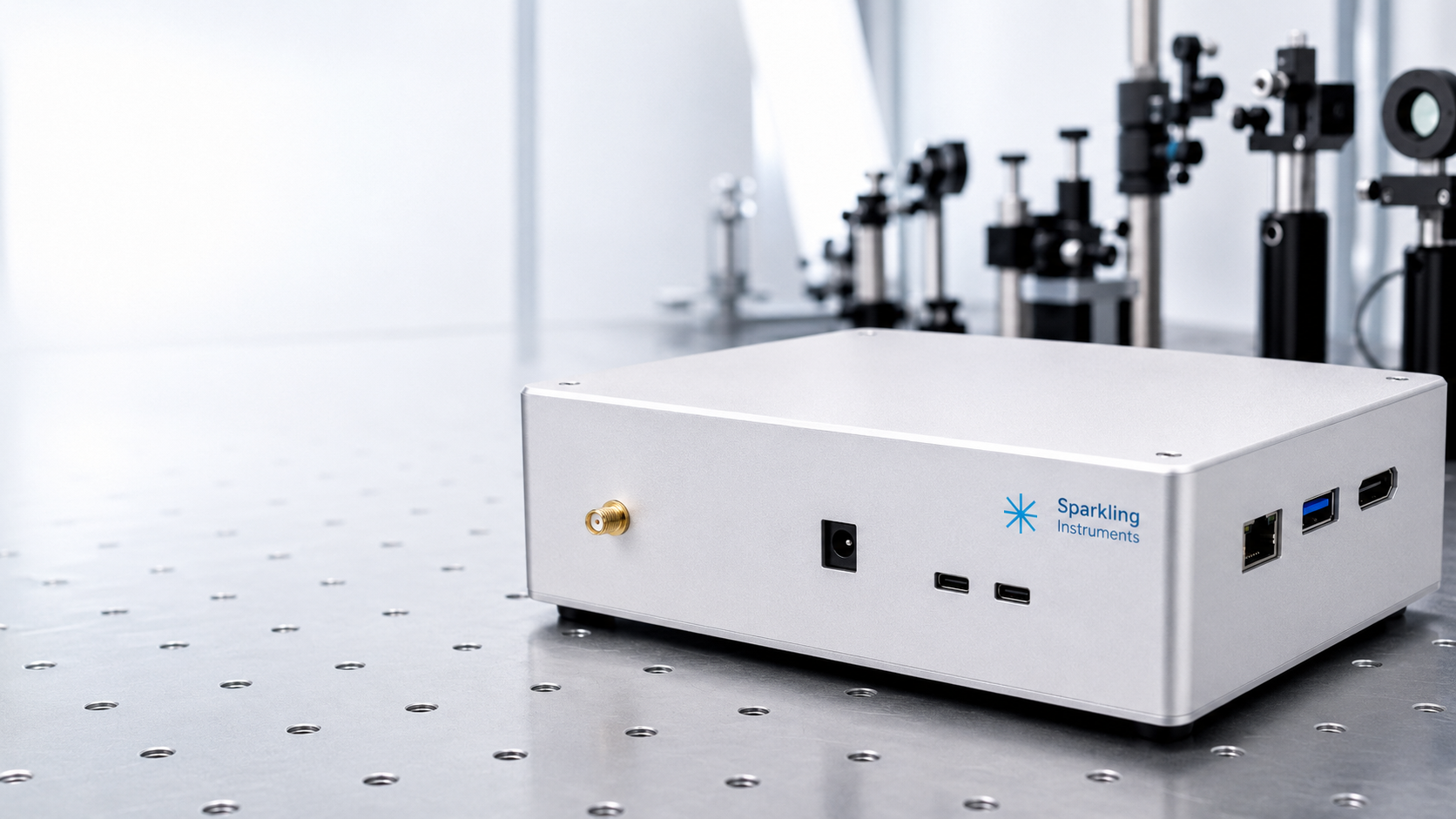
We are introducing our photon-counting modules to the European market and working directly with early labs, system integrators, and distribution partners. Tell us about your application and we will discuss technical fit, specifications, and next steps.
Who it is for
The module is intended for professional R&D environments where photon-counting capability needs to be evaluated, integrated, or embedded into a larger optical, measurement, or automation system.
Quantum optics, photonics, and time-resolved measurement teams looking for a practical module.
Lifetime measurements, photon arrival statistics, and low-light detection workflows.
Time-of-flight evaluation and single-photon detection in early-stage system prototypes.
Teams considering photon counting as a component inside a larger instrument or product.
Lab equipment resellers and photonics distributors seeking a complementary product line.
Automation developers and photonics consultants supporting research and industrial customers.
Module overview
Our single-photon counting module is designed for professional R&D, laboratory prototyping, and system integration use cases. It supports photon counting and timing workflows where users need a practical hardware module combined with clear software and integration support.
Our goal is to make photon-counting hardware easier to evaluate and integrate — not only to supply the module.
Sparkling Instruments combines a reliable hardware manufacturing source with a European point of contact, documentation, software interfaces, and integration support. The aim is to make the module practically usable for EU research and integration teams, not only to ship a part.
Technical specifications
Figures reflect the current hardware datasheet (typical values). The module time-tags and counts single-photon pulses from your detector — final specifications are confirmed for your channel count, detector, and configuration during evaluation.
| Specification | Value |
|---|---|
| Status | Available for evaluation |
| Type | Multichannel single-photon timestamp counter (T2 / T3 time tagging) |
| Input channels | 2 / 4 / 6 / 10 / 18, configurable (including sync and marker channels) |
| Input connector | SMA, 50 Ω input impedance |
| Detector | Works with your single-photon detector (SPAD, PMT, SNSPD) — not included |
| Timestamp resolution | 8 ps |
| Timing jitter | < 10 ps RMS (< 20 ps FWHM) |
| Dead time | 5 ns per channel |
| Count rate | 200 Mcps burst per channel; 40 Mcps sustained, all channels (USB 3.0) |
| Trigger | Rising edge; threshold 0–4.096 V (1 mV steps); 600 ps min. pulse width |
| Measurement modes | Time tagging (T2 / T3 TTTR), real-time histogram, intensity / count-rate, coincidence |
| Real-time histogram | ≥ 65,536 bins, ≥ 8 ps resolution, 64-bit count depth per channel |
| Continuous measurement | Up to ~14.5 h with no timestamp-overflow handling; unlimited with overflow handling |
| Reference clock | External 10 MHz input (square wave) |
| Data interface | USB 3.0 |
| Software | Windows SDK, real-time GUI, API documentation, and Python / C++ / LabVIEW examples |
| Dimensions | 205 × 125 × 50 mm |
| Compliance | EU compliance preparation to be completed before broader commercial sales |
A higher-performance configuration is also available — 1 ps timestamp resolution, up to 20 channels, and up to 280 Mcps over 10-gigabit Ethernet. Tell us about your application and we will confirm which configuration fits.
Software & integration
The module ships with a working software stack — SDK, real-time GUI, API documentation, and ready-to-run examples — so you can control the counter and start logging data right away. We keep extending it and want to learn which interfaces and workflows European labs and integrators need most.
C++ dynamic library and headers for full control of the counter from your own application.
Ready-to-run Python, C++, and LabVIEW examples for time tagging, histograms, coincidence, and photon counting.
Live count-rate visualization, configuration, and CSV export — no coding required.
A pip-friendly Python package and command-line tool for scripted acquisition and quick checks.
Clear reference and integration guide for existing acquisition and lab-automation stacks.
Example Jupyter workflows and CSV export for data logging, testing, and analysis.
Tooling marked “in development” is being prioritized from early-user feedback. If a specific interface or workflow matters to you, tell us in the contact form.
Why work with us
We are not trying to replace the established TCSPC and FLIM ecosystems. We focus on being an affordable, flexible, and well-supported choice for teams who want a capable photon-counting module without a premium-ecosystem budget.
Capable single-photon counting and timing without a premium-ecosystem budget — leaving room in the grant for the rest of your setup.
Firmware, SDK, output format, and integration adapted to your experiment. As a small team we can tailor things a large vendor will not.
Talk to the people who built the counter, with fast EU-based turnaround — not a ticket queue.
Scriptable SDK and examples in Python, C++, and LabVIEW. Build your own workflow instead of a locked analysis suite.
Best when you need:
Best when you need:
Both are good choices — for different jobs. For full turnkey FLIM systems and the broadest application ecosystem, established vendors are excellent. We focus on an affordable, flexible, well-supported module for teams who want exactly that.
Partners
We are looking for distributors, lab equipment resellers, photonics consultants, and system integrators who can help bring this module to European research and industrial customers.
Contact us about partnershipContact
We are collecting feedback from early users and partners to shape the EU product introduction. Share a short note about your application, technical requirements, and what kind of collaboration you are interested in.